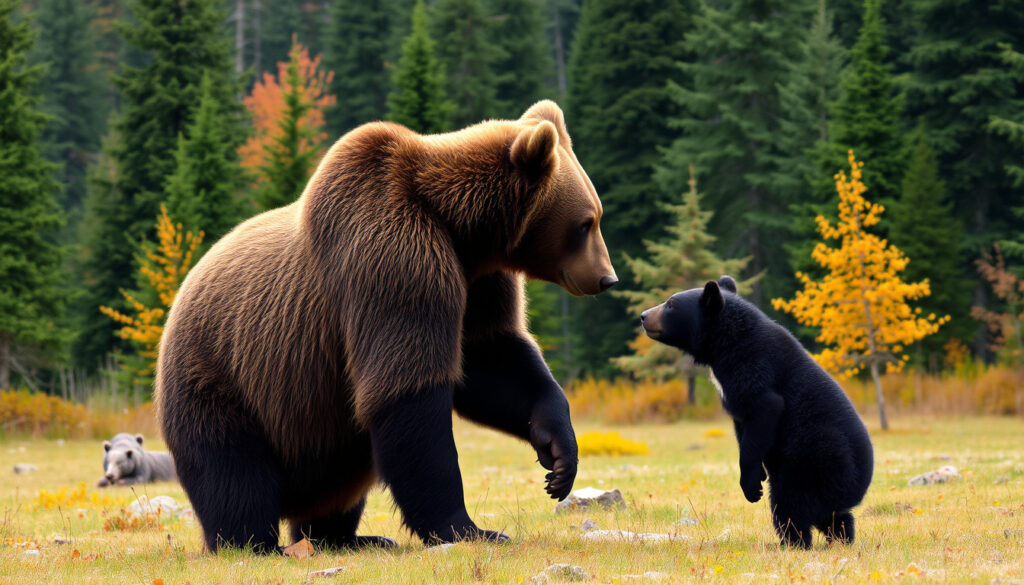
Grizzly Bear vs Black Bear: Aggression, Deterrents & Facts
You’ve heard the warnings about grizzly bears: they’re huge, aggressive, dangerous, but most attacks are defensive. This article separates fact from fear, comparing grizzly and black bear behavior, explaining why they’re called “grizzly,” and examining what science says about deterrents and strength.
Average weight (male): 600 lbs (272 kg) ·
Average height standing: 8 ft (2.4 m) ·
Top running speed: 35 mph (56 km/h) ·
Lifespan in wild: 22–26 years ·
Geographic range: North America (Alaska, western Canada, northwestern US)
Quick snapshot
- Grizzly bears are the North American subspecies of brown bear (U.S. Fish & Wildlife Service)
- Their name comes from the “grizzled” appearance of their fur (National Wildlife Federation blog)
- Black bears are generally less aggressive than grizzlies (North American Bear Center)
- Bear spray is an effective deterrent for both species (BearWise)
- Exact population numbers in remote areas due to the animals’ elusive nature
- Long-term effects of climate change on grizzly habitats
- Whether a gorilla or grizzly is “stronger” in absolute terms (no direct evidence)
- 1805 – Lewis and Clark Expedition documents the “grizzly” bear (Wikipedia)
- 1975 – Listed as threatened in the lower 48 under the Endangered Species Act (U.S. Fish & Wildlife Service)
- 2023 – Estimated 1,500–1,700 grizzlies remain in the contiguous U.S. (U.S. Fish & Wildlife Service)
- Recovery efforts continue in Yellowstone and Northern Rockies ecosystems (U.S. Fish & Wildlife Service)
- Public education on bear safety and food storage remains a priority (National Park Service)
Seven key specs, one takeaway: the grizzly is a massive, powerful omnivore built for strength and speed — not for hunting humans.
| Attribute | Value |
|---|---|
| Scientific Name | Ursus arctos horribilis |
| Subspecies of | Brown bear (Ursus arctos) |
| Weight Range (Male) | 400–790 lbs (180–360 kg) |
| Height Standing | 6–8 ft (1.8–2.4 m) |
| Top Running Speed | 35 mph (56 km/h) |
| Lifespan | 22–26 years in wild |
| Primary Habitat | Alaska, western Canada, Yellowstone & Glacier regions |
Who is more aggressive, a black bear or a grizzly bear?
The short answer: grizzlies. But context matters. Let’s break down the data.
Which bear has killed the most humans?
In North America, grizzly bears are responsible for more fatal attacks than black bears, though fatalities are rare for both species. According to the North American Bear Center (wildlife research center), attacks by mother black bears defending cubs are extremely rare, with no recorded fatality from that scenario. Grizzlies, by contrast, are more prone to defensive aggression when surprised, especially around food or cubs (National Park Service).
How dangerous are black bears compared to grizzly bears?
Black bears rarely attack humans; most conflicts stem from habituation or surprise. Grizzlies, however, require a different safety response. The National Park Service advises playing dead if attacked by a grizzly, but fighting back if attacked by a black bear — a clear distinction in risk profile.
Three behavior patterns, one contrast: grizzlies defend territory; black bears flee.
| Trait | Black Bear | Grizzly Bear |
|---|---|---|
| Aggression level | Low; usually retreats | Moderate-high when surprised or protecting food/cubs |
| Attack trigger | Habituation, threat to cubs (rare) | Surprise encounter, defense of resources |
| Recommended defense | Fight back if attack persists (NPS) | Play dead, then fight back if attack continues (NPS) |
| Fatal encounter rate | Extremely low; <0.1 per year in U.S. (estimated) | Low; 1–2 per year in North America (estimated) |
Bottom line: Grizzlies are biologically more prone to defensive aggression than black bears. Hikers in grizzly country: carry bear spray and know the “play dead” protocol. Hikers in black bear country: stand your ground and be prepared to fight back.
The wrong response can turn a non-fatal encounter into a tragedy. The National Park Service explicitly distinguishes protocols by species. Knowing which bear you’re facing is a life-or-death distinction.
What part of a human does a bear eat first?
This gruesome question often comes from curiosity about predatory attacks — but the vast majority of encounters are defensive, not predatory.
Do bears prey on humans or attack defensively?
Bears are opportunistic omnivores. Their diet consists primarily of berries, nuts, roots, fish, and small mammals (Wikipedia). Human attacks are almost always defensive — the bear feels cornered, surprised, or is protecting cubs or a food cache. In the rare instances where a bear does prey on a human, research by bear expert Stephen Herrero indicates that the head and neck are often targeted first due to high fat and nutrient density (Wikipedia, citing Herrero’s work).
How do bears consume their food?
As omnivores, bears eat a wide variety. Coastal grizzlies can consume up to 40 pounds of food per day during hyperphagia (pre-hibernation feeding), relying heavily on salmon (U.S. Fish & Wildlife Service). Meat makes up a small proportion compared to plant matter.
Bears are powerful enough to kill a human, but they almost never do. More people die from bee stings or lightning than from bear attacks each year. The fear far exceeds the threat.
The implication: bears are powerful but rarely predatory.
Why are bears called grizzly?
The name has a double origin — part appearance, part historical confusion.
What is the origin of the name ‘grizzly’?
The term “grizzly” comes from “grizzled,” meaning silver-tipped or frosted fur. Explorers Lewis and Clark first described the bear as “grisly” (meaning horrible), and later confusion with “grizzled” led to the modern name (National Wildlife Federation blog). The scientific name Ursus arctos horribilis includes a Latin root meaning “horrible” (NWF blog).
How does the grizzly bear’s appearance relate to its name?
Grizzly bears typically have brown fur with white or silver tips on the back and shoulders, giving a “grizzled” appearance. This silver sheen is most noticeable in adults (Wikipedia).
The name captures both its appearance and the fear it inspires.
What smell does a bear hate?
Bears rely heavily on their sense of smell, but certain odors can deter them — at least temporarily.
What smells do bears hate?
Strong odors such as ammonia, pine, and citrus are reported to be unpleasant to bears, though their effectiveness is inconsistent. The most reliable chemical deterrent is bear spray — a concentrated capsaicin spray derived from red pepper (BearWise). The Alaska Department of Fish and Game (state wildlife authority) notes that bear spray is a close-range tool and should never replace common-sense avoidance measures.
Which deterrents are effective for keeping bears away?
- Bear spray – most effective immediate deterrent; proven to reduce injury severity (BearWise)
- Food storage – proper use of bear canisters and hanging food prevents habituation (National Park Service)
- Making noise – hiking in groups and calling out reduces surprise encounters (NPS)
- Aversive conditioning – using unpleasant tastes or smells to teach bears to avoid human areas (ongoing research)
The Interagency Grizzly Bear Committee (federal bear-management body) emphasizes: never run from a bear, stand your ground, and discharge bear spray if the bear charges within close range.
The pattern: reliable deterrents combine prevention with reaction.
Who is stronger, a grizzly or a gorilla?
A common online debate — but the answer relies on biomechanics, not battlefield evidence.
What verifies gorilla strength compared to grizzly bears?
No verified physical confrontation exists. Comparisons are based on size, bite force, and observed behavior. Grizzly bears are far larger: adult males weigh 400–790 lbs (U.S. Fish & Wildlife Service), while male gorillas typically weigh 300–500 lbs (Wikipedia). Pound for pound, gorillas have a stronger bite relative to body size, but a grizzly’s massive claws and ferocity give it a clear advantage in a hypothetical fight.
How do size and bite force compare?
Grizzlies have a shoulder hump of muscle for digging and a bite force estimated at 1,200 psi. Gorillas have a bite force of about 1,300 psi, but their smaller size and lack of claws make them less suited for a fight with a bear. The Wikipedia entry for grizzly bears notes that no interspecies conflicts have been documented, so any “winner” is speculative.
Gorillas are smarter and more agile; grizzlies are bigger, stronger, and equipped with natural weapons. In a one-on-one, the bear’s size and claws would likely prevail — but the question says more about human fascination with imaginary matchups than real biology.
The catch: the comparison is speculative but highlights the grizzly’s physical dominance.
Confirmed facts
- Grizzly bears are a North American subspecies of brown bear. (U.S. Fish & Wildlife Service)
- Their name comes from the “grizzled” appearance of their fur. (National Wildlife Federation blog)
- Bear spray is an effective deterrent. (BearWise)
What’s unclear
- Exact population numbers in remote areas due to elusive nature.
- Long-term effects of climate change on grizzly habitats.
- Whether a gorilla or grizzly is “stronger” in absolute terms (no direct evidence).
- Black bears’ comparative aggression levels relative to grizzlies in all contexts.
Expert perspectives
“Most grizzly attacks are defensive and occur when the bear is surprised at close range.”
Stephen Herrero, author of Bear Attacks: Their Causes and Avoidance (recognized bear attack researcher)
“Black bears are less likely to attack humans than grizzlies, but both should be given space.”
North American Bear Center (wildlife research and education center)
For anyone venturing into bear country, the implication is clear: carry bear spray, make noise, and know which species lives in your region. The wrong safety response can turn a close encounter into a tragedy.
sabrered.com, reddit.com, counterassault.com, magazine.byu.edu, igbconline.org, funtrivia.com
Frequently asked questions
Do grizzly bears hibernate?
Yes, grizzly bears enter a deep sleep (torpor) during winter, typically from October to May, reducing their metabolism and living off fat stores. They are not true hibernators but can be roused if disturbed (National Park Service).
What is the difference between a grizzly bear and a brown bear?
Grizzly bears are a North American subspecies of brown bear (Ursus arctos horribilis). Brown bears also live in Europe and Asia; they are the same species but differ slightly in size and behavior (U.S. Fish & Wildlife Service).
How fast can a grizzly bear run?
Grizzly bears can reach speeds up to 35 mph (56 km/h) over short distances — faster than a human can sprint (Wikipedia).
What should you do if you encounter a grizzly bear?
Stand your ground, avoid direct eye contact, speak calmly, and slowly back away. Do not run. If the bear charges, use bear spray. If attacked, play dead by lying flat on your stomach, covering your neck (National Park Service).
Are grizzly bears endangered?
In the lower 48 states, grizzly bears are listed as threatened under the Endangered Species Act. Their populations are stable in Alaska and Canada. Approximately 1,500–1,700 remain in the contiguous U.S. (U.S. Fish & Wildlife Service).
How many cubs do grizzly bears have?
Female grizzlies typically give birth to 1–4 cubs every 2–4 years. Cubs stay with their mother for up to 3 years (Wikipedia).
Can grizzly bears climb trees?
While capable of climbing, adult grizzlies are not as adept as black bears due to their size and long, straight claws. Young grizzlies can climb, but adults often rely on other escape tactics (National Park Service).
More related posts
 Report a Problem Apple – Step-by-Step Refund Guide
 Toronto to Thunder Bay Flights: Cheap Deals from $61
 Kortney Wilson: New Husband, Divorce, and Career Comeback 2025
 Canadiens Game Summary: Score, Standings & Price Update
 Dan Shulman: Wife, Salary, and Net Worth in 2025
 John Elway: Health, Super Bowl Wins, and Life After Football
 Tom Cruise Ana de Armas – Relationship Timeline 2025
 Why Is Anna Wintour Such a Big Deal? Net Worth, Family & Career
