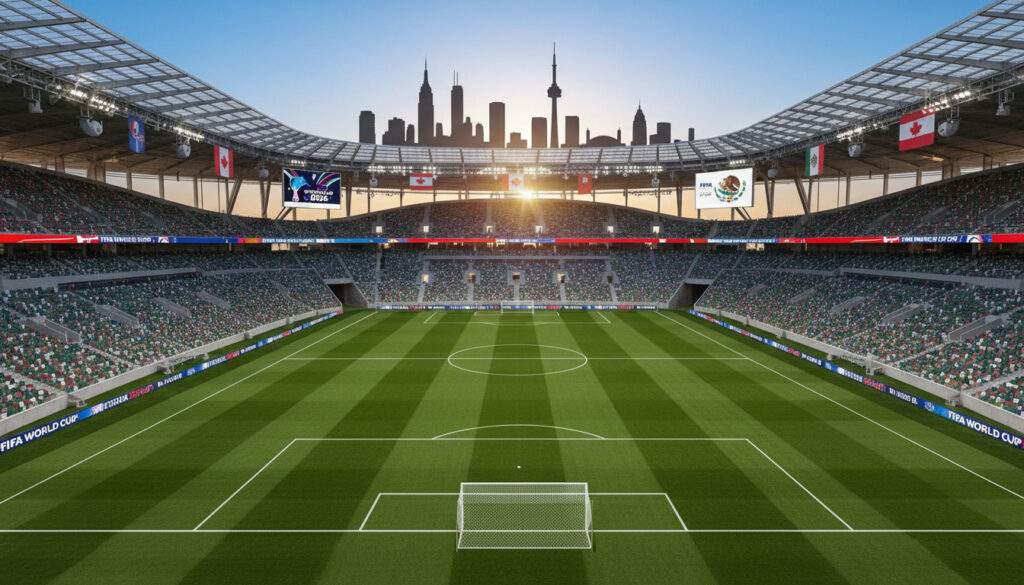
Coupe du Monde de Football 2026 – Hosts, Venues, Dates and Format
The 2026 FIFA World Cup will unfold across North America from June 11 to July 19, 2026, marking the first edition co-hosted by three nations and the debut of an expanded 48-team format. Sixteen cities in the United States, Canada, and Mexico will stage 104 matches over 39 days, making this the largest tournament in the competition’s history.
Awarded to the “United Bid” in 2018 over Morocco by a decisive 134-65 vote, the tournament breaks new ground in logistics and scale. Mexico becomes the first country to host three World Cups, while Estadio Azteca in Mexico City will become the first stadium to host matches in three separate tournaments, opening the competition on June 11.
All 16 venues are existing stadiums undergoing significant upgrades to meet FIFA standards, with the majority of fixtures concentrated in the United States. The final will take place at MetLife Stadium in the New York/New Jersey metropolitan area on July 19, capping the expanded 104-match programme.
Where Will the 2026 FIFA World Cup Be Held?
USA, Canada, Mexico
16 total (11 USA, 3 Mexico, 2 Canada)
MetLife Stadium, New York/New Jersey
Estadio Azteca, Mexico City
Key Facts About the Host Nations and Venues
- This marks the first time three nations will co-host the tournament
- Mexico becomes the first country to host three World Cups (previously 1970 and 1986)
- Estadio Azteca will be the first stadium to host matches in three separate World Cups
- FIFA divided venues into eastern, central, and western regions to minimize travel
- All 16 venues are existing stadiums requiring upgrades for capacity and facilities
- The United States will host over 60 of the 104 matches
- The final will be held at MetLife Stadium on July 19, 2026
Venue Specifications
| FIFA Designation | Usual Name | City/Area | Country | Key Notes |
|---|---|---|---|---|
| Atlanta Stadium | Mercedes-Benz Stadium | Atlanta | USA | Group stage |
| Boston Stadium | Gillette Stadium | Boston | USA | |
| Dallas Stadium | AT&T Stadium | Dallas (Arlington) | USA | |
| Houston Stadium | NRG Stadium | Houston | USA | |
| Kansas City Stadium | GEHA Field at Arrowhead | Kansas City | USA | |
| Los Angeles Stadium | SoFi Stadium | Los Angeles | USA | |
| Miami Stadium | Hard Rock Stadium | Miami | USA | |
| New York New Jersey Stadium | MetLife Stadium | New York/New Jersey | USA | Final (July 19) |
| Philadelphia Stadium | Lincoln Financial Field | Philadelphia | USA | |
| San Francisco Bay Area Stadium | Levi’s Stadium | San Francisco Bay | USA | |
| Seattle Stadium | Lumen Field | Seattle | USA | |
| Estadio Guadalajara | Estadio Akron (Omnilife) | Guadalajara | Mexico | |
| Estadio Monterrey | Estadio BBVA | Monterrey | Mexico | |
| Mexico City Stadium | Estadio Azteca | Mexico City | Mexico | Opening match (June 11); 9 matches incl. semi-final |
| Toronto Stadium | BMO Field | Toronto | Canada | |
| BC Place Vancouver | BC Place | Vancouver | Canada | 2 Canada group matches |
FIFA announced the 16 host cities on June 16, 2022, selecting them from 23 proposed sites based on logistics, infrastructure capacity, and regional distribution. The selection process prioritized existing venues capable of meeting expanded capacity requirements through upgrades rather than new construction.
When Is the 2026 World Cup and What Is the Schedule?
Tournament Dates and Duration
The tournament runs from June 11 to July 19, 2026, spanning 39 days. This extended window accommodates the expanded 48-team format and increased match count of 104 games, up from 64 in previous editions. The full tournament schedule was released in early 2024.
Key Fixtures
The opening match kicks off on June 11 at Estadio Azteca in Mexico City. The final is scheduled for July 19 at MetLife Stadium, officially designated as New York New Jersey Stadium for the tournament. These anchor fixtures frame a competition that distributes matches across three nations with the majority concentrated in the United States.
Regional Organization
To manage logistics across three countries and 16 venues, FIFA organized the stadiums into eastern, central, and western regions. This regional clustering aims to minimize travel distances for teams and fans during the group phase, though the knockout stage may require longer transit between the host nations.
While the tournament framework and venue assignments are confirmed, specific match pairings beyond the opening fixture and final depend on qualification outcomes. FIFA has indicated the final draw will likely occur in late 2025.
How Many Teams and What Is the Format for 2026?
Expansion to 48 Teams
The 2026 edition introduces the expanded 48-team format, an increase from the 32-team structure used since 1998. This expansion adds 16 additional national teams to the competition, representing a significant shift in tournament scope and representative geography.
Competition Structure
The format features an expanded group stage followed by knockout rounds. While exact group configurations follow FIFA’s new model with 12 groups, the structure accommodates more group games than previous tournaments to facilitate the additional teams before proceeding to elimination rounds.
Match Volume
With 48 teams competing, the tournament comprises 104 total matches—the most in World Cup history. This represents a significant increase from the 64 matches played in the 2022 and 2018 editions, requiring additional rest days and venue availability across the extended 39-day window.
How Does Qualification Work for the 2026 World Cup?
The qualification process allocates 45 slots to competing confederations, with three additional automatic berths reserved for the host nations. The United States, Mexico, and Canada automatically qualify as co-hosts without participating in regional qualifiers. CONCACAF qualification processes for the remaining slots are ongoing.
Confederations currently conduct their own qualification tournaments to determine the remaining participants. UEFA, CONMEBOL, and other regional bodies manage these processes independently, with matches underway during the 2023-2025 period.
Specific qualification paths and final slot allocations by confederation remain subject to ongoing FIFA consultations. The final list of qualified teams will be determined by the end of 2025, ahead of the tournament draw.
As co-hosts, the United States, Canada, and Mexico receive automatic qualification without competing in regional qualifiers. This marks the first time three host nations receive direct entry for the same tournament.
Timeline of the 2026 World Cup Bid and Preparation
- : FIFA awards the 2026 tournament to the North American “United Bid” over Morocco by a vote of 134-65 during the 68th FIFA Congress in Moscow.
- : FIFA officially announces the 16 host cities selected from 23 proposed sites.
- : FIFA releases the full tournament schedule, confirming dates and venue assignments.
- –: Qualification tournaments proceed across global confederations to determine 45 of the 48 participating teams.
- (Expected): Final tournament draw to assign qualified teams to groups and specific venues.
What Is Confirmed and What Remains Uncertain
| Established Information | Information Awaiting Confirmation |
|---|---|
| Host countries: USA, Canada, Mexico | Exact composition of final 48 teams pending qualification outcomes |
| Tournament dates: June 11-July 19, 2026 | Specific group stage matchups beyond opening game |
| 48-team format with 104 matches | Final tournament draw date (likely late 2025, not confirmed) |
| All 16 venues and their FIFA designations | Official ticket pricing and public sale dates |
| Opening match and final locations | Full hospitality package availability and pricing |
| Host nations automatically qualified | Specific referee and official assignments |
Historical Context of the Triple-Host Bid
The 2026 tournament represents a watershed moment for the World Cup as the first co-hosted by three nations. The “United Bid” submitted by the United States, Canada, and Mexico defeated Morocco’s candidacy during the 68th FIFA Congress in Moscow.
Mexico’s participation marks its record third time hosting, having previously staged the 1970 and 1986 tournaments. Estadio Azteca will achieve a unique milestone by becoming the first venue to host matches in three separate World Cups, having served as the final venue in both previous Mexican-hosted editions.
The decision to expand to 48 teams and utilize existing infrastructure across North America reflects FIFA’s strategic shift toward larger-scale events with reduced new construction requirements. All 16 selected venues are existing stadiums undergoing renovations rather than purpose-built facilities, with upgrades including added seating, video screens, and hospitality areas.
Official Statements and Sources
The 16 selected cities represent the best of North American soccer culture, offering existing infrastructure and transportation networks capable of supporting an expanded 48-team tournament.
— FIFA Host City Announcement, June 16, 2022
All venues will meet or exceed FIFA capacity requirements through modernization of existing facilities, with particular attention to pitch dimensions and broadcast capabilities.
— U.S. Soccer Federation Bid Documentation
Looking Ahead to 2026
The road to the 2026 World Cup continues through 2025 as confederations finalize their qualification tournaments. Travel packages and hospitality options are already being marketed through authorized vendors, though official ticket sales through FIFA channels have not yet commenced. With the schedule established and venues confirmed, attention shifts to the final draw and the operational logistics of staging matches across three nations.
Frequently Asked Questions
Which stadium will host the 2026 World Cup final?
MetLife Stadium in the New York/New Jersey metropolitan area will host the final on July 19, 2026.
How many teams will compete in the 2026 World Cup?
The tournament expands to 48 teams, up from 32 in previous editions, playing 104 matches total.
Do the host nations automatically qualify for the 2026 tournament?
Yes, the United States, Canada, and Mexico receive automatic qualification as co-hosts.
When does the 2026 World Cup start and end?
The tournament runs from June 11 to July 19, 2026, lasting 39 days.
Which country will host the opening match?
Mexico will host the opening match on June 11, 2026, at Estadio Azteca in Mexico City.
How were the 16 host cities selected?
FIFA selected the cities from 23 proposed sites based on logistics, infrastructure, and regional distribution to minimize travel.
Will new stadiums be built for the 2026 World Cup?
No, all 16 venues are existing stadiums undergoing upgrades to meet FIFA standards for capacity and facilities.
How can fans buy tickets for the 2026 World Cup?
Official tickets will be available through FIFA’s official channels, though specific sale dates and pricing have not been announced.
More related posts
 Dan Shulman: Wife, Salary, and Net Worth in 2025
 Report a Problem Apple – Step-by-Step Refund Guide
 Tony Robbins: Biography, Diagnosis, Net Worth, and Criticisms
 Hatsune Miku: Age, Anime Appearances, and Common Myths
 Winnipeg Jet Playoff Schedule 2025: Round 2 Update
 Megan Thee Stallion: Biography, Net Worth, Relationship & Career
 Alexander Isak: Biography, Injury, Wife, Religion, Family
 Chloë Grace Moretz: Age, Net Worth, Relationships, and More
