Hatsune Miku: Age, Anime Appearances, and Common Myths
If you’ve typed “Hatsune Miku” into a search bar, you probably already know the silhouette: turquoise pigtails, a pixel-perfect voice, and a global fanbase that treats her like a pop star. But here’s the thing — she’s not a person. She’s a piece of software, a voice synthesizer package released by Crypton Future Media (Japan’s leading voice-synthesis developer) in 2007, and she’s been at the center of some very human questions ever since. This article separates the official facts from the fan-built stories.
“Miku is a singing voice synthesizer featured in over 100,000 songs worldwide.” — Crypton Future Media
Name: Hatsune Miku · First Appeared: August 31, 2007 · Age (Official Lore): 16 years old · Height: 158 cm (5’2″) · Voice Provider: Saki Fujita · Based On: Vocaloid 2 Engine
Quick snapshot
- Virtual singer created by Crypton Future Media (voice-synthesis developer)
- Voice provided by Saki Fujita (voice actress)
- First released in 2007 (Crypton Future Media (voice-synthesis developer))
- Age: 16 per official Crypton profile
- Height: 158 cm (Crypton profile)
- Birthday: August 31 (Crypton profile)
- Music video star and live hologram performer (Project DIVA (Sega’s rhythm game series))
- Central character in Project DIVA (Sega’s rhythm game series)
- Cameo appearances in some anime (Project DIVA (Sega’s rhythm game series))
- No official sexual orientation
- No official autism status
- Age is 16, not 18
“Hatsune Miku is software developed to make a computer sing songs.” — The Japan Foundation
Miku is a singing voice synthesizer — not an AI, not a real person. Crypton describes her as “a singing voice synthesizer” featured in over 100,000 songs worldwide, a fact that often gets lost amid her pop-star presence.
The following table compiles official specifications from Crypton Future Media.
| Attribute | Official Value | Source |
|---|---|---|
| Name | Hatsune Miku | Crypton Future Media (official profile) |
| Debut | August 31, 2007 | Wikipedia (editorial encyclopedia) |
| Voice Engine | Vocaloid 2 | Wikipedia |
| Age (Lore) | 16 | Crypton Future Media |
| Height | 158 cm | Crypton Future Media |
| Weight | 42 kg | Crypton Future Media |
| Gender | Female | Crypton Future Media |
| Voice Range | A3–E5 | Crypton Future Media |
In what anime is Hatsune Miku in?
What anime series feature Hatsune Miku?
Hatsune Miku does not have her own anime series. She is a software mascot, not an anime character with a scripted storyline. CBR (pop culture editorial outlet) notes that while she has become a modern anime icon, she doesn’t star in a serialized show. Instead, she has made brief cameo appearances in projects such as “The Tiger and the Fish” — usually as background Easter eggs — and shows up on posters in opening sequences of other anime.
What video games include Hatsune Miku?
Her biggest gaming presence is the Project DIVA series, a set of rhythm games published by Sega. She is the central performer in those games. She also appears in the mobile rhythm game Project Sekai: Colorful Stage! feat. Hatsune Miku, developed by Sega and Colorful Palette (game developer).
The pattern: Miku’s presence in anime is limited to Easter eggs, not starring roles.
Is Miku LGBTQ?
Does Hatsune Miku have a defined sexuality?
Crypton Future Media (the official rights-holder) has never defined Hatsune Miku’s sexual orientation. There is no official statement, no character bio entry, and no public document that assigns her a sexuality. Fan interpretations vary widely — some artwork and fan stories depict her as LGBTQ, but these are purely fan creations, not canon.
Official stance: No defined sexuality · Fan speculation rate: High · Canon status: Zero
Treating fan-made LGBTQ headcanons as official facts misrepresents both the character and the fans. The real story: Miku is a blank canvas, and what fans project onto her isn’t wrong — it’s just not Crypton’s published truth.
The implication: Miku is a tool for creative expression, and like any blank slate, she gets interpreted in thousands of ways. But those interpretations are not official facts.
Is Hatsune Miku ok for kids?
What is the content of Hatsune Miku songs?
Hatsune Miku herself is a virtual character with no inherent mature content. She is a voice bank — she sings whatever lyrics a creator programs. Individual songs may cover romantic, sad, or even mature themes, so parents should review lyrics on a case-by-case basis. Crypton markets her as appropriate for general audiences, and her official profile avoids any suggestive content.
Are there age restrictions for Hatsune Miku concerts?
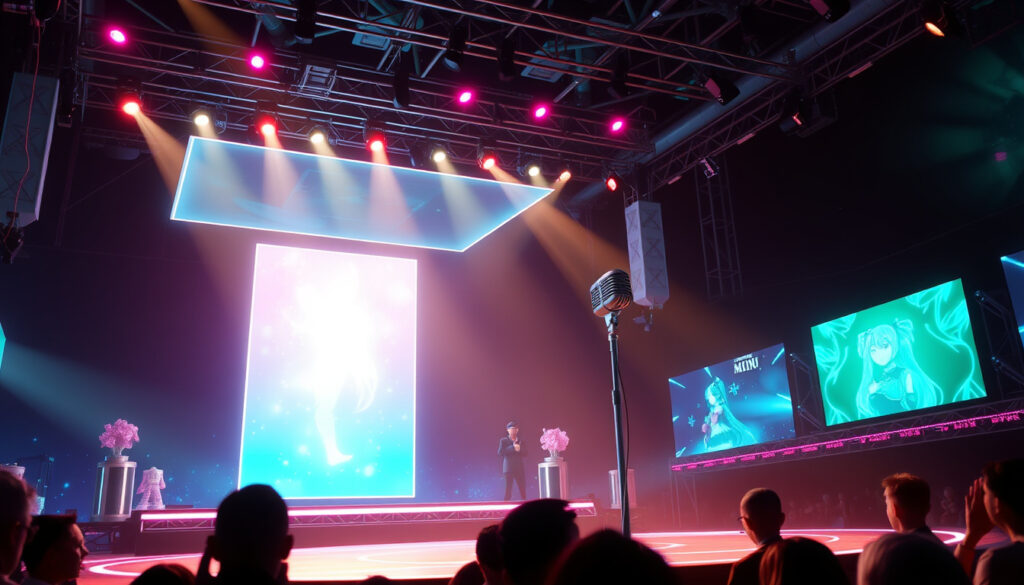
Official concerts, such as the Miku Expo tour, are generally family-friendly. The main concerns are loud music levels and large crowds, not explicit content. Wikipedia (community-sourced encyclopedia) describes her live shows as “animated holographic projections” that focus on music performance, not theatrical storytelling.
No age restriction exists on Miku herself. But the fan-created ecosystem — including some fan art and lyrics — may not be child-safe. Treat Miku like a search engine: the tool is neutral, but content made with it varies.
Why this matters: the question “Is Miku OK for kids?” is really about who is using her and what they create. The tool itself is clean; the ecosystem is what parents should monitor.
Is Miku 16 or 18?
What is Hatsune Miku’s official age?
Officially, Hatsune Miku is 16 years old. This is listed on Crypton Future Media’s official profile (the rights-holder’s definitive details). Her birthday is August 31, and since her 2007 debut, she has never “aged up” in canon — she remains perpetually 16.
Why is Miku portrayed as 16?
The age 16 was not arbitrary. It was chosen to represent the concept of “the first sound from the future” — young, fresh, and forward-looking. Crypton’s founder described the logic as “the first sound from the future.” This connects to her name: Hatsune Miku means “The first Sound from the Future” per Crypton’s official explanation (developer statement). She is also code-named CV01, a formulaic naming that reinforces her role as the prototype.
Age in lore: 16 · Birthday: August 31 · Canon aging: None · Name meaning: “First sound from the future”
The pattern: some fan communities portray her as 18, but that is not canon. Official merchandise and Crypton’s site consistently show age 16.
Is Hatsune Miku autistic?
Are there any official statements about Miku and autism?
There is no official confirmation that Hatsune Miku is autistic. Crypton Future Media has never issued any statement describing her as neurodivergent, autistic, or having any mental health condition. This question arises entirely from fan interpretation.
Why do some fans think Miku is autistic?
Some fans interpret her behavior — often shown as socially awkward, focused on singing, or detached from social norms — as neurodivergent traits. This is speculative. Miku has no personality canon beyond what fans create; she is a voice bank with a visual design, not a character with a psychological profile.
Miku behaves the way she does because she’s a software program, not because she has a personality disorder. Fans projecting autism onto her is a sign of how much people want her to be a real person — but it’s not grounded in official information.
The trade-off: Miku’s blankness is both her strength (fans can project anything onto her) and the source of confusion (people assume she has a personality). The answer to “Is Miku autistic?” is no — she isn’t anything, because she isn’t a person.
reddit.com, youtube.com, vocaloid.fandom.com, actipedia.org, reddit.com, virtualhumans.org, facebook.com, reddit.com, tjf.or.jp
For a deeper dive into common misconceptions, check out this detailed guide on Hatsune Miku facts and myths.
Frequently asked questions
How does Hatsune Miku’s voice synthesis work?
Miku uses Yamaha’s Vocaloid 2 engine, which samples human voice recordings (from Saki Fujita) and allows users to input lyrics and melody to generate singing.
What is Vocaloid software?
Vocaloid is a singing voice synthesizer software developed by Yamaha. Users type in lyrics and melody, and the software sings them using a recorded voice database.
Who created Hatsune Miku?
She was created by Crypton Future Media, a Japanese company based in Sapporo, and first released on August 31, 2007.
What is Hatsune Miku’s favorite color?
Her official color is turquoise (teal), reflected in her hair and design. There is no “favorite” in lore — it’s a visual branding choice.
Does Hatsune Miku have a real person behind her voice?
Yes — her voice is provided by Saki Fujita, a Japanese voice actress. But Miku is not Fujita; she is a synthesized version of Fujita’s voice recordings.
Are Hatsune Miku concerts real or holographic?
Concerts use rear-cast projection on specially coated glass to create an animated holographic illusion. She is not physically present (she’s software), but the performance is real.
What is the meaning of ‘Hatsune Miku’?
It means “The first Sound from the Future,” reflecting her role as the first Japanese Vocaloid from Crypton Future Media.
More related posts
 Shahid Kapoor: Biography, Love Life, Movies & Age (2025)
 Homicide: Life on the Street – Why It Ended, Where to Watch
 Canada Carbon Rebate October 2025 – No Payment Scheduled
 Alexandre Texier Contract Termination: Full Story
 Ms. Rachel: Biography, Net Worth, and Family Facts
 24 Carat Gold Price in Canada – Live CAD Rates and Trends
 Tyler Hynes: Bio, Age, Height, Movies, Relationship Status
 Red Chris Mine Rescue: 3 Miners Trapped, Rescued After 60 Hours
