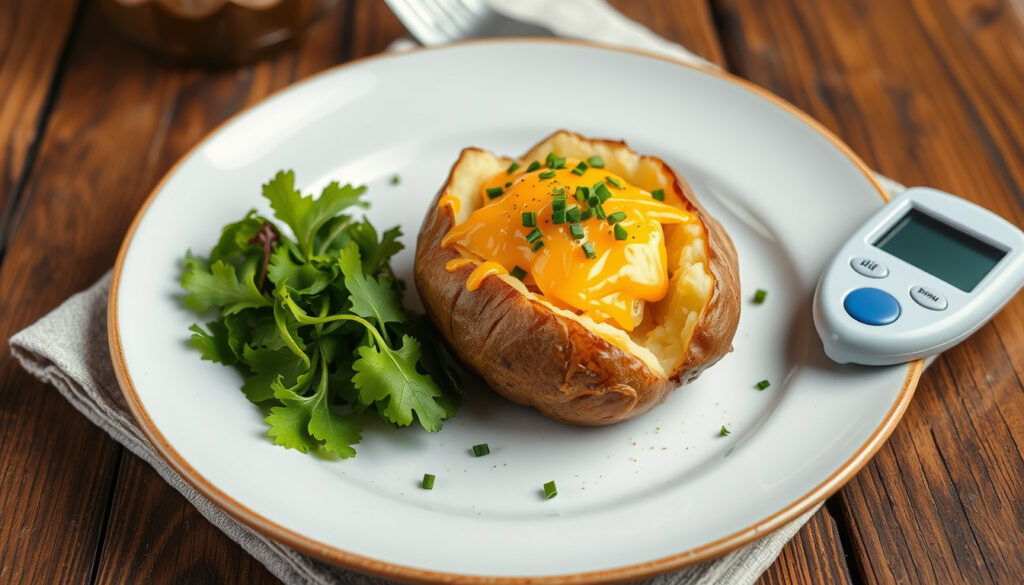
Twice Baked Potato Recipe: Gordon Ramsay Tips & Diabetic Options
There’s something deeply satisfying about a potato that gets baked twice — the first time to set the stage, the second to finish with a golden, crispy top and a creamy, flavorful center. This twice baked potato recipe draws on Gordon Ramsay’s restaurant techniques, including a crucial resting step, while also offering practical swaps for anyone watching blood sugar.
Baking temperature: 400°F (200°C) ·
Total cooking time: 1 hour 15 minutes ·
Calories per half potato: ~350 kcal ·
Protein per serving: 10 g ·
Carbohydrates per serving: 45 g
Quick snapshot
- Twice-baked potatoes are baked whole, scooped, mixed with fillings, then baked again (Serious Eats (test kitchen))
- Gordon Ramsay’s recipe includes sautéed savoy cabbage for added fiber (Gordon Ramsay YouTube)
- Resting after first bake helps moisture redistribute for fluffier texture (Serious Eats test kitchen) (Serious Eats (test kitchen))
- Exact internal temperature for perfect twice-baked texture
- Whether Gordon Ramsay officially endorses a specific twice-baked potato recipe beyond the YouTube video
- Key timing: 30 min first bake at 400°F, then 10 min second bake for crisping (Gordon Ramsay YouTube)
- Try diabetes-friendly swaps: Greek yogurt for sour cream, roasted cauliflower for half the potato (EatingWell (healthy recipe site))
Here is a quick reference of key facts about twice-baked potatoes.
| Attribute | Detail |
|---|---|
| Origin | Unknown; popularized in mid-20th century American cuisine |
| Key ingredients | Potatoes, butter, sour cream, cheese, bacon, green onions |
| Popular variations | Greek-style with feta and oregano, loaded with chili, or vegetarian |
| Gordon Ramsay technique | Includes sautéed savoy cabbage, butter mash, and a 15-minute rest before scooping (Gordon Ramsay YouTube) |
| Diabetic-friendly swap | Replace butter with olive oil or Greek yogurt; add broccoli for fiber (EatingWell) |
| Best potato type | Russet or Maris Piper – floury varieties yield fluffiest texture (NutritionValue (nutrition database)) |
How to make twice-baked potatoes Gordon Ramsay?
Gordon Ramsay’s twice-baked holiday potatoes follow a precise method: whole large potatoes are baked at 400°F (200°C) for about 30 minutes until crisp outside and cooked through (Gordon Ramsay YouTube). After a short rest, they’re halved, scooped, and the flesh is mashed with butter and sautéed savoy cabbage – a fiber-rich addition that makes the dish more diabetic-friendly than the usual cheese-heavy filling.
- Preheat oven to 400°F (200°C). Scrub potatoes, pat dry, rub with olive oil and salt. Prick with a fork.
- Bake potatoes directly on the oven rack for 30 minutes until skin is crisp and flesh is tender. Remove and let rest 15 minutes.
- Cut potatoes in half lengthwise. Scoop out flesh into a bowl, leaving a thin shell. Mash flesh with butter, sour cream, sautéed cabbage, chives, and half the cheese.
- Refill shells, top with remaining cheese. Bake for 10 minutes more until golden and bubbly. Serve hot.
What ingredients does Gordon Ramsay use?
- Large floury potatoes (Russet or Maris Piper) – ideal for a fluffy interior (NutritionValue)
- Butter, sour cream, cheese, chives – classic dairy richness
- Savoy cabbage – 3.6 g fiber per 100 g, lower glycemic impact (Nutritionix (nutrition data))
- Breadcrumb topping for extra crunch
How does the 15-minute rule apply to potatoes?
While Ramsay’s famous 15-minute rest is typically associated with steaks, the same principle works for baked potatoes: letting them sit after the first bake allows steam to settle and starches to set, preventing a gluey texture. Serious Eats confirms that resting potatoes before scooping helps the interior stay light and fluffy (Serious Eats test kitchen).
What step ensures crispy skin?
Before the first bake, rub the potato skins with olive oil and salt – this draws out surface moisture. Then, after filling the shells, return them to a hot oven (400°F) for 10–15 minutes until the edges are golden and crackling. Ramsay cranks up the heat for that final crisping stage (Gordon Ramsay YouTube).
The combination of a floury potato, a short rest, and a high-heat finish is what separates a soggy twice-baked potato from a restaurant-worthy one. Even home cooks can nail it with these three steps.
What is the point of a twice-baked potato?
The double bake serves two ends: a crispy outer shell that stays firm, and a creamy interior you can customize with mix-ins. Unlike mashed potatoes (which are all one texture), twice-baking creates a deliberate contrast – crackly skin, soft filling.
What texture does twice-baking achieve?
The first bake cements the potato’s structure; the second bake dries the mashed interior slightly, concentrating flavor and creating a thin, crisp top. Serious Eats describes the result as “a cross between a baked potato and a casserole” (Serious Eats test kitchen).
How is it different from mashed potatoes?
- Mashed potatoes are boiled, drained, and mashed – no skin involved, often looser.
- Twice-baked potatoes use the potato skin as a vessel, retain more structure, and can be prepared ahead and reheated.
The “twice” part sounds like twice the work, but in practice the second bake is hands-off. The payoff is a dish that’s actually more freezer-friendly than standard mashed potatoes, making it a make-ahead champion.
The implication: twice-baking transforms a simple potato into a structured, customizable dish that holds up better than mashed alternatives.
How do restaurants get their baked potatoes so fluffy?
Restaurant potatoes come out fluffy because of three techniques: oil-rubbing, pricking, and resting. Each step tackles a different part of the potato’s moisture and starch chemistry.
What oil or butter is used?
Most chefs rub the raw potato skin with olive oil and coarse salt before baking. This draws out moisture during cooking, ensuring the skin crisps rather than steams. Butter can be added after baking for flavor, but oil is preferred for the initial seal (Serious Eats test kitchen).
Why is pricking the skin important?
Pricking the potato with a fork before baking allows steam to escape, preventing the potato from bursting in the oven. It also promotes even cooking throughout the flesh (Gordon Ramsay YouTube).
Does resting after baking matter?
Yes – let the potato rest for 10–15 minutes after the first bake. This allows the internal starches to set and the moisture to redistribute evenly, which is why Ramsay’s rule applies equally to potatoes as to steak. The result: a fluffy, not gummy, interior (Serious Eats test kitchen).
The implication: these same restaurant secrets work for any home oven. No special equipment needed.
What to pair with twice-baked potatoes?
Twice-baked potatoes are rich, so they pair best with lean proteins and fresh sides that cut through the creaminess.
What main dishes complement twice-baked potatoes?
- Steak (ribeye or sirloin) – classic steakhouse combo
- Roast chicken – light meat balances the potato’s heaviness
- Grilled fish (salmon or cod) – omega-3 fats contrast with the dairy
Are there side dishes that work well?
- Light green salad with vinaigrette – acidity cuts richness
- Steamed broccoli or green beans – fiber and color
- Roasted asparagus – earthy crunch
If you’re planning a meal around these stuffed potatoes, see our Best Banana Bread Recipe for a comforting dessert that pairs neatly with the same meal, or Recette Tartare de Saumon for a fresh starter.
The richness of twice-baked potatoes can eclipse lighter sides. For a balanced plate, keep the potato serving to half a potato per person and load up the vegetables.
The catch: portion control matters. Half a potato per person keeps the meal balanced without sacrificing indulgence.
Are Potatoes Good For Type 2 Diabetes?
White potatoes score high on the glycemic index (GI 80–90), which means they can raise blood sugar quickly. But the American Diabetes Association doesn’t ban potatoes – it emphasizes portion control and pairing with protein and fiber (American Diabetes Association (clinical guidelines)).
Can diabetics eat baked potatoes in moderation?
Yes – a single baked potato (about 150–200 g) contains roughly 30 g of net carbs. The ADA recommends keeping net carbs per meal under 45–60 g for many adults. So half a twice-baked potato fits comfortably (Healthline (nutrition resource)).
How does preparation affect blood sugar impact?
Adding protein (cheese, Greek yogurt) and fiber (cabbage, broccoli) slows glucose absorption. The skin also contains fiber. HealthMatch notes that eating potatoes with the skin and pairing with protein lowers the glycemic response (HealthMatch (health information platform)).
Which is better for a diabetic, baked potato or French fries?
French fries are worse: they absorb more oil during deep-frying, and high cooking temperatures create acrylamide, a potential toxin. Baked or twice-baked potatoes are the smarter choice (Mayo Clinic (medical institution advice)).
The catch: preparation trumps type. A twice-baked potato with cabbage and Greek yogurt can be part of a diabetes-friendly meal, while the same potato deep-fried is not.
Different potato varieties yield different results for twice-baking.
| Variety | Floury texture? (best for twice-baked) | Net carbs per 100g | Ramsay’s choice? |
|---|---|---|---|
| Russet | Yes – high starch, low moisture | ~21 g | Yes (commonly used) |
| Maris Piper | Yes – floury British classic | ~17 g | Yes (UK recipes) (NutritionValue) |
| Yukon Gold | Medium – waxy, less fluffy | ~19 g | No (recommended for mashing) |
The pattern: choosing a floury potato variety is the first step to achieving the right texture for twice-baking.
What we know and what’s still unclear
Confirmed facts
- Twice-baked potatoes are baked, scooped, mixed with fillings, then baked again
- Gordon Ramsay’s recipe includes sautéed savoy cabbage
- Diabetic guidelines recommend limiting high-glycemic potatoes but allow moderate portions
- Resting after first bake improves fluffiness
What’s unclear
- Exact internal temperature for perfect twice-baked texture
- Whether Gordon Ramsay officially endorses a specific twice-baked potato recipe beyond the YouTube video
Expert perspectives on twice-baked potatoes
“Shred one third of savoy cabbage and sauté in butter with a dash of water until tender… then mix into the mashed potato for a lighter, more flavorful filling.”
— Gordon Ramsay (via YouTube)
“Eating potatoes with the skin and pairing with protein can reduce the glycemic impact, making them a reasonable choice for people with type 2 diabetes.”
— HealthMatch (health information platform)
“For diabetics, the best way to prepare potatoes is baked with skin, served with a source of protein and non-starchy vegetables.”
— Apollo 247 (health guidance)
The takeaway from three distinct sources: technique and portion scope are everything. A twice-baked potato made with smart swaps can satisfy without compromising health goals.
For the home cook who wants both indulgence and control, the choice is clear: master Ramsay’s resting rule, replace half the starch with cabbage or cauliflower, and serve with a lean protein. That’s the path to a twice-baked potato that actually delivers on its promise – crispy, creamy, and adaptable.
For a quicker alternative that still delivers crispy skin and a fluffy interior, try the air fryer baked potato method as a base for your twice-baked filling.
Frequently Asked Questions
Can I freeze twice-baked potatoes?
Yes – assemble the potatoes completely but do not bake the second time. Wrap tightly in foil and freeze for up to 3 months. Bake straight from frozen, adding 10–15 minutes to the second bake time.
How long do twice-baked potatoes last in the fridge?
Stored in an airtight container, they keep for 3–4 days. Reheat in a 350°F oven for 15–20 minutes to restore crispness.
What cheese is best for twice-baked potatoes?
Cheddar (sharp or mild) is the classic choice. For a lower-fat option, try part-skim mozzarella or a sprinkle of Parmesan. Greek yogurt can replace some cheese for creaminess with less fat.
Can I use sweet potatoes instead?
Yes, but sweet potatoes have a different moisture content and will be slightly less fluffy. The glycemic index of sweet potatoes is lower (~44), making them a good option for diabetics (Healthline).
How do I reheat twice-baked potatoes without drying them out?
Cover with foil and warm in a 325°F oven for 15 minutes, then remove foil and bake 5 minutes more to re-crisp the top. Avoid microwaving, which softens the skin.
Can I make twice-baked potatoes ahead of time?
Absolutely. Prepare the whole dish, refrigerate after the second bake, and reheat when needed. Or stop after stuffing and refrigerate, then bake the second time just before serving.
More related posts
 Sri Lanka Women v India Women: Match Scorecard & Highlight
 Why Is Anna Wintour Such a Big Deal? Net Worth, Family & Career
 2026 Winter Olympics Medals: Predictions, Table & France Chances
 Winnipeg Jet Playoff Schedule 2025: Round 2 Update
 When Are Taxes Due 2026 Canada: Key CRA Deadlines
 Largest Countries by Land Mass – Top 10 Rankings and Facts
 Courtney Hadwin: AGT Finalist to Independent Artist in 2025
 Man City vs Aston Villa – 2-1 Dramatic Victory Report
