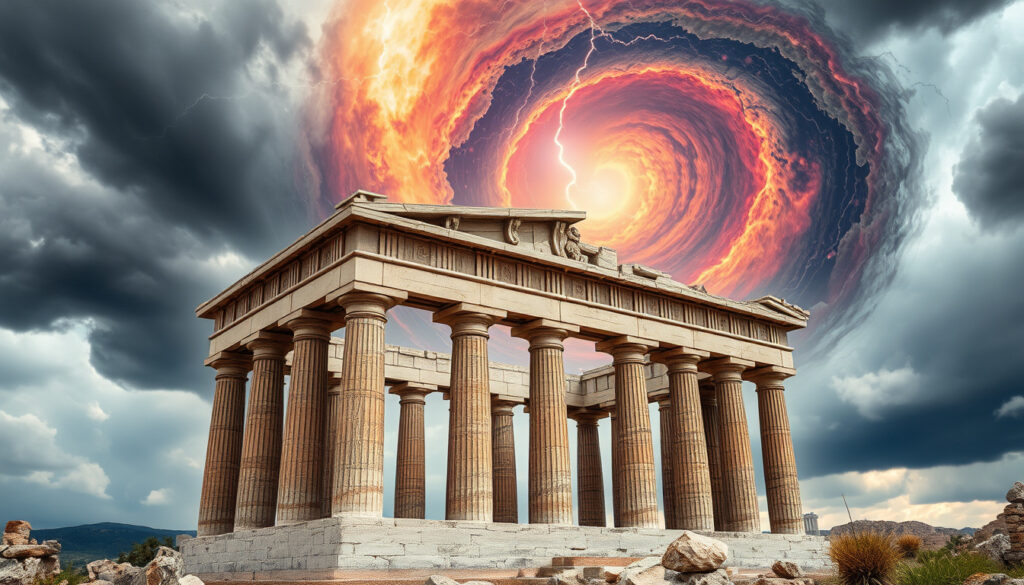
Greek Gods: Olympians, Primordials & Key Myths
If you’ve ever tried to name all the Greek gods, you’ve probably noticed the list changes depending on who you ask. But the core group — the Twelve Olympians led by Zeus — is the one most of us know. This guide sorts out the classic lineup, introduces the primordial beings that came before, and tackles a few of the most-asked myths around these ancient figures.
Olympian gods: 12 · Chief god: Zeus · Pantheon categories: Olympians, Titans, Primordials
Quick snapshot
- The Twelve Olympians are a family of deities who resided on Mount Olympus (Wikipedia)
- The canonical list includes Zeus, Hera, Poseidon, Demeter, Athena, Apollo, Artemis, Ares, Aphrodite, Hephaestus, Hermes, and either Hestia or Dionysus (Athens Glance)
- Theoi Greek Mythology classifies the pantheon into Olympians, Titans, Primordials, daemones, and deified mortals (Theoi)
- Some traditions place Hestia in the Twelve instead of Dionysus (Athens Glance)
- The membership of the Twelve varied by city-state and evolved over centuries (Theoi)
- The classification system established by ancient Greeks continues to shape modern scholarly study of mythology (Theoi)
- God names like Zeus, Apollo, and Artemis survive in astronomy and popular culture, reinforcing their lasting cultural footprint (Athens Glance)
| Label | Value | Source |
|---|---|---|
| Number of Olympians | 12 | Wikipedia |
| Chief Olympian | Zeus | Wikipedia |
| Olympians reside on | Mount Olympus | Wikipedia |
| First-generation Olympians | Zeus, Poseidon, Hera, Demeter, Hestia | Wikipedia |
| Later Olympians | Aphrodite, Athena, Artemis, Apollo, Ares, Hephaestus, Hermes, Dionysus | Wikipedia |
| Dodekatheon meaning | “twelve gods” | Athens Glance |
The six rows above cover the core canonical facts — but the real picture is more fluid, as the ancient Greeks themselves disagreed on the exact roster.
What are the 12 Greek gods?
When someone asks for the 12 Greek gods, they are usually referring to the Olympian council that ruled from Mount Olympus after overthrowing the Titans. The exact lineup depended on time and place, but a broadly accepted classical list includes:
- Zeus – king of the gods, god of the sky and thunder (Theoi)
- Hera – queen of the gods, goddess of marriage and family (Athens Glance)
- Poseidon – god of the sea, earthquakes, and horses (Wikipedia)
- Demeter – goddess of agriculture and the harvest (Theoi)
- Athena – goddess of wisdom, craft, and strategic warfare (Athens Glance)
- Apollo – god of the sun, music, prophecy, and healing (Wikipedia)
- Artemis – goddess of the hunt, wilderness, and the moon (Theoi)
- Ares – god of war and bloodshed (Athens Glance)
- Aphrodite – goddess of love, beauty, and desire (Wikipedia)
- Hephaestus – god of fire, metalwork, and craftsmanship (Theoi)
- Hermes – herald of the gods, god of travel, commerce, and thieves (Athens Glance)
- Dionysus (or Hestia) – god of wine, festivity, and ecstasy (or goddess of the hearth) (Theoi)
The pattern: The list is more a cultural tradition than a fixed rule. The key variation — Hestia or Dionysus — reflects a shift in religious emphasis over time. Hestia, the gentle hearth goddess, was often replaced by the more dramatic Dionysus as the pantheon evolved.
The Olympian Council
- The council consisted of the twelve most powerful deities who lived on Mount Olympus (Wikipedia)
- They were third- and fourth-generation immortals who succeeded the Titans (Wikipedia)
The implication: Any single list you find reflects a choice among competing traditions, not a definitive ancient decree.
Who is the oldest Greek god?
Before Zeus and the Olympians, there were the primordial gods — the very first beings to exist. According to Hesiod’s Theogony, these entities personified fundamental forces of the cosmos.
Primordial deities
- Chaos – the first entity to come into existence, a void or gap (Theoi)
- Gaia (Earth) – emerged after Chaos, gave birth to the sky and mountains (Wikipedia)
- Tartarus – the deep abyss, later used as a prison for the Titans (Athens Glance)
- Eros (Love) – the force that drives reproduction among the gods (Theoi)
Why this matters: The primordials are not “gods” in the familiar sense — they are personified concepts. This distinction is crucial for understanding later myths: every major god, including Zeus, is a descendant of these original forces.
“First of all Chaos came into being.” — Hesiod, Theogony (trans. M.L. West)
Who got Medusa pregnant?
In the myth as told by Ovid in his Metamorphoses, Medusa was a beautiful mortal woman who caught the eye of Poseidon. The god of the sea pursued her in Athena’s temple, where the encounter occurred. Enraged by the desecration, Athena transformed Medusa’s hair into serpents and cursed her so that anyone who looked directly at her would turn to stone. Medusa was pregnant by Poseidon, and when the hero Perseus beheaded her, two offspring emerged from her blood: the winged horse Pegasus and the giant Chrysaor.
“Medusa was once a beautiful maiden… Neptune [Poseidon] violated her in the temple of Minerva [Athena].” — Ovid, Metamorphoses (trans. Brookes More)
Who is Zeus’ only male lover?
Zeus had many mortal lovers, but his only acknowledged male lover was Ganymede, a prince of Troy. According to the Homeric Hymn to Aphrodite, Zeus was so captivated by Ganymede’s beauty that he transformed into an eagle, swept the boy up to Mount Olympus, and appointed him as cupbearer to the gods, replacing his daughter Hebe. The myth illustrates how divine favor could elevate a mortal to immortality, and it also reflects the ancient Greek practice of pederasty among the aristocracy.
“Zeus was seized with love for Ganymede, and carried him off to Olympus, where he made him immortal and the cupbearer of the gods.” — Homeric Hymn to Aphrodite
What is Greek for god?
The ancient Greek word for god is theos (θεός). It appears in masculine, feminine (thea), and neuter (theion) forms. The term is the root of modern words like theology, theism, and monotheism. In Greek polytheism, theos could refer to any deity, from Olympians to local spirits, while the abstract noun to theion meant “the divine.”
The pattern: The linguistic flexibility of theos mirrors the fluid categorization of Greek gods—what counted as a god varied by context, much like the roster of the Twelve Olympians.
youtube.com, aongking.com, riordan.fandom.com, mrewert.edublogs.org
Frequently Asked Questions
What are the symbols of Zeus?
Zeus is traditionally associated with the thunderbolt, the eagle, the oak tree, and the aegis (a shield). These symbols reflect his roles as sky god and king of Olympus.
Is Hades considered an Olympian?
Hades is a major god, but he is not counted among the Twelve Olympians because he resided in the underworld, not on Mount Olympus. He is one of the three sons of Cronus, alongside Zeus and Poseidon.
What is the difference between a Titan and a god?
The Titans were the generation of deities before the Olympians. They were overthrown by Zeus and his siblings. Many Olympians are children of Titans, but the term “god” in Greek mythology applies to both groups, though after the Titanomachy the Olympians became the dominant power.
Who is the goddess of wisdom?
Athena, born from Zeus’s head, is the Greek goddess of wisdom, craft, and strategic warfare. She is one of the Twelve Olympians and a patron of Athens.
How many Greek gods are there in total?
The exact number is impossible to fix because Greek religion included countless local deities, spirits, and personified forces. The major pantheon had at least 12 Olympians, dozens of Titans and primordials, and hundreds of minor gods and heroes.
More related posts
 Brooke Monk: Age, Net Worth, Boyfriend, and Rise
 Breaking Bad Jesse Pinkman: Arc, Fate & Key Relationships
 Air Canada Flight Emergency Landing – AC858 Diverted by Unruly Passenger
 Canadiens Game Summary: Score, Standings & Price Update
 What Is Secondary School – Ages, Subjects, Country Variations
 Blue Jays 2025 Pitchers: Rotation, Additions, Ace
 Flight from UIO to MEC: Guide to Quito Airport to Manta Airport
 Sarah Catherine Hook Movies and TV Shows – Complete Filmography
