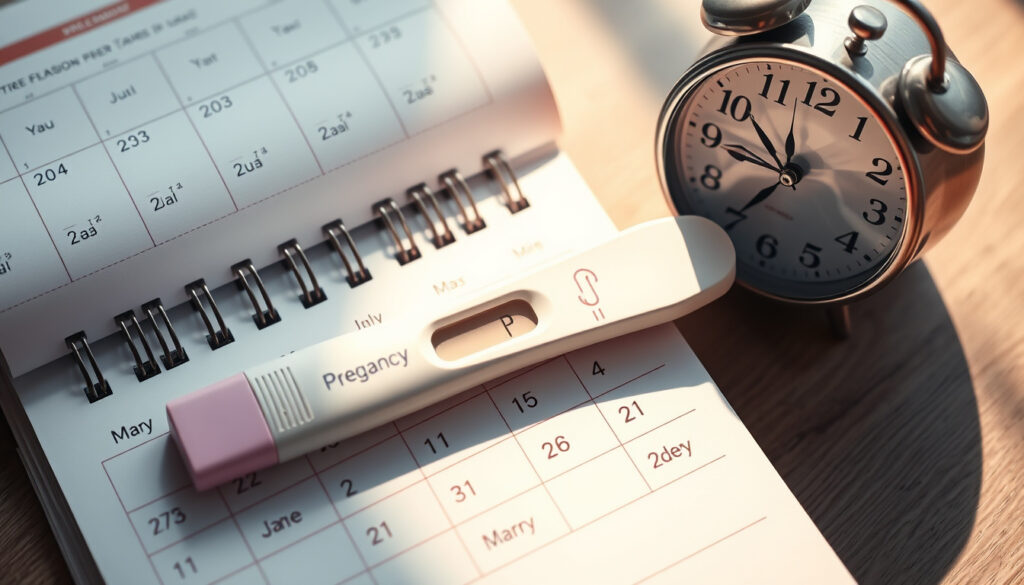
When to Take a Pregnancy Test: Accurate Timing Guide
If you’ve ever found yourself staring at a bathroom shelf, test in hand, wondering if you’re testing too early—you’re not alone. The timing question is one of the most common sources of stress when trying to conceive. Most home pregnancy tests are over 99% accurate from the day you expect your period (Clearblue), yet false negatives happen often enough that countless people test again a few days later, convinced something went wrong. The good news: a few basics about how your body produces the pregnancy hormone and how sensitive your test is can take most of the guesswork out of the equation.
Earliest detection: 4-6 days before missed period · Standard timing: First day of missed period · Post-conception sensitivity: 8-10 days · hCG detection lead: 6 days sooner than missed period · Most accurate wait: 1 week after missed period
Quick snapshot
Here’s what the evidence shows about pregnancy test timing, distilled into actionable categories.
- Most brands deliver ~99% accuracy on the first day of a missed period (Roswell ObGyn)
- Blood tests catch hCG roughly 10-11 days post-ovulation; urine tests need 12-14 days post-conception (Mommed)
- Tests with 25 mIU/mL sensitivity turn positive about 4 days before your expected period (Flo Health)
- The exact day implantation occurs—research pegs it at 6-12 days post-fertilization, but that window varies significantly between individuals (Fox Valley ObGyn)
- How quickly each person’s hCG rises in the earliest days, since doubling rates differ from person to person (Fox Valley ObGyn)
- If your first test is negative but suspicion remains, wait 48-72 hours and retest—hCG levels double rapidly enough that a second test often turns positive (Ohio State Health)
- A blood test at your doctor’s office can confirm what a home test cannot: your specific hCG concentration and whether it’s rising appropriately (Ohio State Health)
The table below summarizes the key detection windows and thresholds for pregnancy testing.
| Metric | Value |
|---|---|
| Earliest home test | 4 days before expected period |
| Government-recommended wait | 21 days after last period |
| hCG detection threshold (early tests) | 6.3 mIU/mL |
| hCG detection threshold (standard tests) | 25 mIU/mL |
| False negative risk | Highest before implantation |
| Blood test earliest detection | 10-11 days post-ovulation |
| Urine test earliest detection | 12-14 days post-conception |
| Implantation window | 6-12 days post-fertilization |
| hCG doubling interval | 48-72 hours |
| Clearblue Early Detection | 6 days before missed period |
How early in pregnancy will it show up on a test?
The short answer depends on which test you use and when implantation actually happens in your cycle. Blood tests win the timing race: a quantitative hCG blood test can detect pregnancy around 10-11 days post-ovulation at roughly 5 mIU/mL, and by 7-8 days post-ovulation, traces may already be present (Mommed). Home urine tests need more hormone to register a positive—they typically require 12-14 days post-conception before reliable detection (American Pregnancy Association).
Days before missed period
Ultra-sensitive home tests calibrated to detect around 6.3 mIU/mL can turn positive as early as 6 days before your expected period, according to Flo Health research (Flo Health). Standard tests with 25 mIU/mL sensitivity typically catch a pregnancy about 4 days before your missed period, or roughly 10 days post-conception. Clearblue’s Early Detection product specifically markets this 6-days-before capability (Clearblue).
Testing before your missed period means risking a misleading negative if implantation hasn’t completed and hCG hasn’t yet crossed the test’s detection threshold. Even with sensitive brands, the safest approach is still to wait until your missed period for reliable results.
Post-conception detection
Implantation, the moment when the fertilized egg attaches to your uterine wall, is what triggers hCG production. That process takes 6-12 days after fertilization, and hCG becomes detectable in blood about 2-3 days after implantation (Fox Valley ObGyn). The implication: even if you know exactly when you had sex, the implantation window introduces a variable of several days that no test can bypass. Clearblue notes that hCG appears 7-9 days post-conception after implantation is complete (Clearblue).
How many weeks pregnant will a pregnancy test be positive?
The medical standard counts pregnancy from the first day of your last menstrual period (LMP), not from the date of conception. This means that at the time of your missed period, you’re already considered about 4 weeks pregnant, even though conception only happened roughly 2 weeks earlier. This gap between gestational age (dated from LMP) and embryonic age (dated from conception) is a frequent source of confusion.
hCG buildup timeline
Once implantation occurs and hCG production begins, levels climb rapidly. In a healthy early pregnancy, hCG doubles approximately every 48-72 hours—a pattern so consistent that deviations from it can signal complications (Mommed). By 4 weeks post-LMP, the typical range spans 5-426 mIU/mL, and by 6-7 weeks that range jumps to 7,650-229,000 mIU/mL (Indira IVF). What this means practically: a test you take at 4 weeks post-LMP (your missed period) is almost always positive if implantation has occurred and the pregnancy is progressing normally.
Week-by-week reliability
By the time you miss your period—at roughly 4 weeks gestational age—home tests are overwhelmingly reliable. Testing about 14 days after ovulation or on the first day of a missed period yields approximately 99% accuracy with most brands (Roswell ObGyn). If you’re testing earlier than your missed period, the reliability drops: at 10 days post-conception, many standard tests will turn positive, but not all. The trade-off is clear—waiting until your missed period gives you the highest confidence in the result.
Because healthcare providers date pregnancies from your last menstrual period, a home test that reads positive at your missed period means you’re already at the 4-week mark. This affects how soon prenatal appointments are scheduled and how early an ultrasound can detect a heartbeat.
Can I be 2 weeks pregnant and test negative?
Yes—this is one of the most common and most misunderstood scenarios in early pregnancy testing. The confusion stems from how pregnancy “weeks” are counted: if you’re counting from conception, you might be technically 2 weeks pregnant when your period is only a few days late. But if you’re counting from your last menstrual period (the medical standard), you wouldn’t be considered pregnant at all yet. This mismatch creates real anxiety when people test and expect an immediate positive.
Reasons for negative results
False negatives occur most often when testing happens before hCG has had enough time to build up to detectable levels. For a standard home test with 25 mIU/mL sensitivity, you need roughly 10 days post-conception before a positive result becomes likely. Ultra-sensitive tests can detect lower levels earlier, but even they can’t guarantee a positive before implantation, which itself takes 6-12 days post-fertilization (Fox Valley ObGyn). Additionally, diluted urine—whether from drinking lots of fluids or testing later in the day—can produce a negative even when hCG is present but not concentrated enough to register.
Flaws in home tests
Home tests are calibrated for convenience, not maximum sensitivity at the earliest possible moment. Most home tests detect hCG from the day your period is due, with sensitive versions able to pick up the hormone a few days before (Clearblue). But no home test can force hCG to appear before implantation occurs. The pattern is consistent: false negatives are common if testing before sufficient hCG buildup, according to Carroll Pregnancy (Carroll Pregnancy). Waiting an extra day or two—or testing first thing in the morning with concentrated urine—can be the difference between a negative and a positive.
Is 7 days too early for a pregnancy test?
Seven days after ovulation—or roughly a week before your period is due—is generally too early for reliable results with home urine tests. This timeline falls within the implantation window (6-12 days post-fertilization), meaning the hormone production that tests detect may not have started yet. Even the most sensitive home tests need a few more days to reach their detection threshold.
Cycle day considerations
On a textbook 28-day cycle, ovulation typically occurs around day 14. Seven days post-ovulation puts you at roughly day 21 of your cycle—still a week away from when your period is expected. In this window, even if conception happened, the embryo may not yet have implanted. Without implantation, no hCG is produced, and no urine test will detect pregnancy regardless of sensitivity. Healthline notes that traces of hCG appear from 6 days post-ovulation, but 7-10 days are needed for detectable levels on tests (Healthline).
28-day cycle guidance
For those with regular 28-day cycles, Ohio State Health recommends testing from the first day after a missed period for the most reliable results, and waiting one full week after a missed period to virtually eliminate false negatives (Ohio State Health). If you test at 7 days post-ovulation and get a negative, that result is essentially meaningless—you need at least 12-14 days post-conception for urine tests to be considered dependable.
Testing at 7 days post-ovulation provides almost no actionable information. An early positive is possible but unlikely; a negative means nothing. Unless your healthcare provider has specifically instructed early testing, waiting until your missed period—or ideally one week after—saves you the cost of tests and the anxiety of a misleading result.
When to take a pregnancy test after missed period?
Your missed period is the single most reliable benchmark for home pregnancy testing. The moment your period doesn’t arrive on schedule, hCG levels in a successful pregnancy have typically risen high enough for standard home tests to detect—generally 12-15 days post-ovulation, when the hormone reaches the threshold most tests are calibrated for (Roswell ObGyn).
First day vs. one week later
The first day of a missed period is already a strong testing point: most home tests are over 99% accurate from the expected period day, as Clearblue states (Clearblue). However, if you can stand to wait, testing one week after your missed period further reduces the already-low false negative risk. Ohio State Health specifically recommends this one-week wait to avoid false negatives and maximize confidence in the result (Ohio State Health).
Brand-specific advice
Different brands have different sensitivity levels, which affects when they can reliably detect pregnancy. Tests calibrated to 25 mIU/mL sensitivity turn positive about 4 days before your expected period; ultra-sensitive tests at 6.3 mIU/mL can detect pregnancy up to 6 days before a missed period (Flo Health). Clearblue Early Detection explicitly markets this 6-days-before capability (Clearblue). But even these ultra-sensitive tests have a catch: they’re more prone to false negatives if used too early, when hCG is present but below detection threshold. For more information, consult folat o àcid fòlic.
When to Take a Pregnancy Test: Step-by-Step
Three steps to get the most accurate result from a home pregnancy test.
- Track your cycle. Know the first day of your last period and estimate your ovulation window. For a regular 28-day cycle, this is typically around day 14. If you have irregular cycles, wait at least 14 days after intercourse before testing.
- Choose your testing window. The earliest you should test is 4-6 days before your expected period if using an ultra-sensitive test (6.3 mIU/mL). For standard tests (25 mIU/mL), wait until 4 days before. The most reliable result comes on the first day of your missed period—or one week after.
- Use first-morning urine. hCG concentrates in urine overnight, making morning samples the most reliable for early detection. Avoid drinking excessive fluids before testing, as this dilutes the sample. If you test negative but still suspect pregnancy, wait 48-72 hours and test again with a fresh sample.
What Pregnancy Tests Can and Cannot Tell You
Understanding what information home tests actually provide—and what they don’t—prevents unnecessary anxiety and missed follow-up care.
What tests confirm
- Positive result means hCG is present above the test’s detection threshold
- Home tests are over 99% accurate from the day your period is due
- A negative result before a missed period does NOT rule out pregnancy
- Blood tests at a clinic can quantify exact hCG levels
What tests cannot tell you
- How far along the pregnancy is (gestational age requires ultrasound)
- Whether the pregnancy is located in the uterus (ectopic pregnancies produce hCG too)
- Whether hCG is rising at a healthy rate (requires serial blood tests)
- The exact date of conception or implantation
“Testing on the first day of your missed period yields approximately 99% accuracy with most brands.”
— Roswell ObGyn (OBGYN Clinic)
“In a healthy, early pregnancy, HCG levels exhibit a very specific and predictable pattern: they double approximately every 48 to 72 hours.”
— Mommed (Health Blog)
“All home pregnancy tests are over 99% accurate from the day you expect your period.”
— Clearblue (Pregnancy Test Brand)
The timing decision ultimately comes down to managing two competing risks: the impatience of waiting versus the frustration of a false negative. For most people with regular cycles, testing on the first day of a missed period balances accuracy with the earliest possible confirmation. If you’ve been trying to conceive, resist the temptation to test at 7 days post-ovulation—waiting those extra days means the difference between a definitive answer and a result you’ll second-guess. Once you have that positive test in hand, schedule a follow-up with your healthcare provider: a blood test can confirm the result, establish a baseline hCG level, and set the timeline for everything that follows.
Related reading: When to take a pregnancy test for accurate results · Best time to take pregnancy test
While early tests tempt those eager for answers, experts in the best timing guide highlight waiting until the first day of a missed period for 99% accuracy.
Frequently asked questions
What hormone do pregnancy tests detect?
Pregnancy tests detect human chorionic gonadotropin (hCG), a hormone produced by the placenta after implantation. hCG appears in blood roughly 7-9 days post-conception and in urine a few days later, depending on test sensitivity. Its levels double every 48-72 hours in early pregnancy, which is why a second test a few days after a negative can often turn positive.
How accurate are pregnancy tests?
Most home pregnancy tests claim over 99% accuracy from the day you expect your period, according to Clearblue. However, accuracy drops significantly when testing before a missed period. A 2014 study found that even sensitive tests miss pregnancies at very early stages. Blood tests at a clinic are more sensitive and can detect lower hCG levels earlier than home urine tests.
What should I do if my test is negative but I suspect pregnancy?
Wait 48-72 hours and test again using first-morning urine. hCG doubles every 2-3 days in early pregnancy, so a result that was too low to detect today may register positive tomorrow. If you continue to get negative results but still suspect pregnancy after your period is more than a week late, schedule a blood test with your healthcare provider for a definitive answer.
Can medications affect pregnancy test results?
Most medications do not interfere with home pregnancy tests. However, fertility treatments that include hCG injections (such as some IVF protocols) can cause a false positive. Antacids and excessive water intake can dilute urine and potentially cause a false negative. If you’re on fertility treatments or taking any medication that might affect hormone levels, consult your healthcare provider about interpreting results.
When should I see a doctor for confirmation?
Schedule an appointment as soon as you get a positive home test. Your healthcare provider can confirm the result with a blood test, establish your baseline hCG level, and begin prenatal care planning. If you’ve had multiple negative tests but still haven’t gotten your period, a doctor can help investigate other causes of missed or delayed menstruation.
What is “pregnancy mouth”?
“Pregnancy mouth” is an informal term sometimes used to describe changes in oral health during early pregnancy, such as gum sensitivity, bleeding gums, or changes in taste. While not a reliable indicator of pregnancy on its own, hormonal changes during early pregnancy can affect oral tissues. If you notice unusual oral symptoms alongside a missed period, this could be one of many early pregnancy signs worth noting when discussing symptoms with your provider.
How does cycle length affect testing?
Irregular cycles make it harder to know when to test. If your periods vary significantly in length, wait at least 14 days after intercourse before testing. For regular cycles, test on the first day of your missed period. The fewer cycles conform to a predictable pattern, the more you rely on waiting a fixed number of days post-intercourse rather than cycle-day calculations.
Are there differences between brands?
Yes. The main difference is sensitivity—measured in mIU/mL. Standard tests detect around 25 mIU/mL and can turn positive about 4 days before your expected period. Ultra-sensitive tests detect around 6.3 mIU/mL and may detect pregnancy up to 6 days before a missed period. Digital tests typically use the same underlying chemistry but convert the result to ” Pregnant” or “Not Pregnant” text for easier reading. All brands are over 99% accurate when used on or after the day of a missed period.
More related posts
 2026 Winter Olympics Medals: Predictions, Table & France Chances
 Super Visa Canada 2025: Eligibility, Rules, and Guide
 Stacy Keibler: Biography, Net Worth, Relationships, and WWE Career
 Yukon Striker: World’s Tallest, Fastest, Longest Dive Coaster
 Andrew Santino: Biography, Career, Podcast & Personal Life
 The Beast in Me Episodes: List, Summaries & Guide
 2 Cups Flour in Grams: Accurate Conversions & Charts
